Sunday, July 17, 2016

Showers and more showers… of petals from trees!


Rainbow Shower trees / Kapiolani Park / July 2016

It is a beautiful time of year in Hawai’i when our flowering trees are in full color! I have been waiting to do this blog to highlight one of my favorite sights - high season of our colorful, showy Rainbow Shower trees. 

Apparently many others over the years share my love as the Rainbow Shower tree is the official tree of Honolulu! Article

I left for a trip in early June and very few Shower trees were blooming. When I returned in the third week of June, the bursting forth blossoming beauty had begun! 


Ever since mid-June, I have been gathering Shower tree photos and I think the blooms have been increasing constantly. Now everywhere I turn the trees are in full glory! 

Rainbow Shower trees / along H-1 in Aiea area / July 2016
As usual as I plan and frame a blog in my mind I make many new observations and questions also come to mind. Research provides many answers and also provides some great facts. 

Here are some of my observations and questions:

Yellow-white Shower tree / Target, Salt Lake area / June 2016

1) The blooms on the yellow-white Shower tree take a hanging form. 

Yellow-white Shower tree / Target, Salt Lake area / June 2016


Golden Shower tree / Pearl City / July 2016

2) The Golden Shower tree seems less common. I believe some people confuse the Golden Shower tree with the Golden tree. 

The photo below of the two together is poorly taken and has bad examples of each but I couldn't resist the two together! Usually the Golden tree is generally much taller. 

Golden Shower tree and Golden tree / Aiea Elementary School / July 2016
The Golden tree flowers are singular and take the form of a generalized flower. The leaves are also long and grayish green rather than compound with many small leaflets as the Golden Shower tree has. [Discussed in: March 24, 2016 - “Spring is Sprung” - look to the trees!]

3) In how many colors do Shower trees bloom? Are there different varieties of the Rainbow Shower or yellow-white or Golden Shower tree? 

I have seen some more yellow and some more pink shades of the Rainbow Shower tree. From the little information out there, there are varieties of the Shower trees. (Source about varieties)

Rainbow Shower tree / Halawa by freeway / July 2016
Rainbow Shower tree / Kapiolani Park / July 2016

yellow-white Shower tree / Aiea / July 2016
This singular Golden Shower tree (unusually found in a neighborhood) looks like less bright of a yellow. The yellow-white Shower tree is more yellow than some.
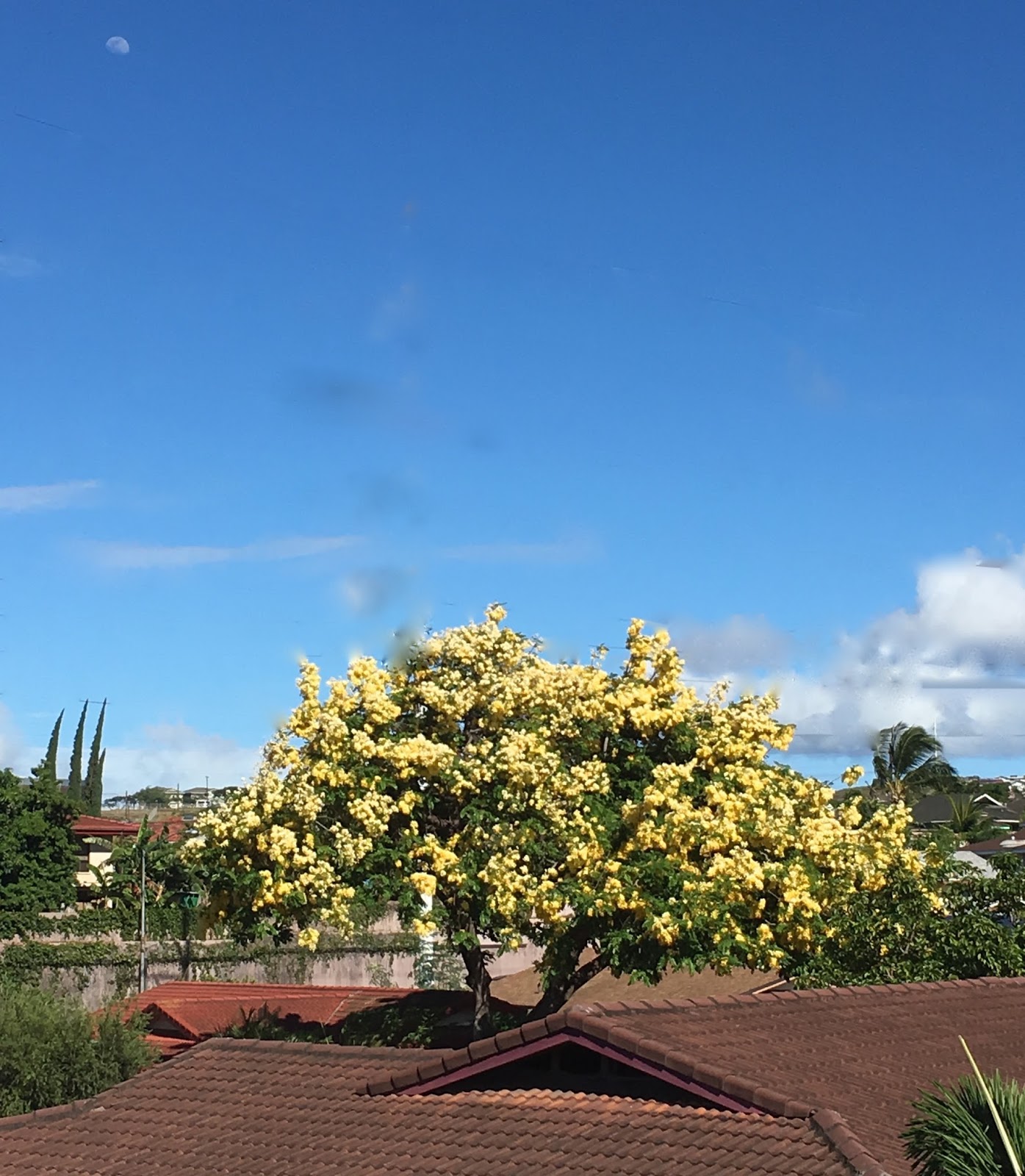
Golden Shower tree / Salt Lake area / July 2016
4) What is their country of origin?  The Rainbow Shower is a hybrid which originates from Hawai’i. ( More information )
Rainbow Shower tree / Pearl City / July 2016 
5) Do the different varieties bloom at different times? (I knew I saw some bloom many months ago.) If you look closely at this photo, which I took in April, the flowers are basically a darker pink so I assume this is a Coral Shower tree which does bloom earlier. Notice too the pods indicating the Shower trees are in the ever present Fabaceae (or Leguminosae) family. [Discussed in: March 10, 2016  - Winter flowering plants / trees in Hawai’i]
Coral Shower tree / Moanalua area / April 2016
6) The trees are very rare in neighborhoods. Like the Golden Tree, the lack in neighborhoods is probably due to the origin of their name - the showers of petals! It is beautiful to see but most people do not want the overwhelming build up of showering petals in the yard. 

Petals falling off Shower trees / Pearl City / July 2016 


petals off a Shower tree / Pearl City / July 2016
7) Although not in yards, luckily the trees are the predominant freeway or roadway tree! Beautiful examples are found in parks also.
Rainbow Shower trees / H-1 interchange / July 2016

yellow-white Shower trees / Kapiolani Park / July 2016

Final notes about the lovely Shower trees: 

1) After research, I found that the delicate yellow-white trees are actually the Queen’s Hospital Shower tree. (Origin of the yellow-white tree) As an aside, when you take photos you never know what gets caught in the background. Look at the lovely Fairy Terns above the tree!
Queen’s Hospital Shower tree / Kapiolani Park / July 2016
2) Many different colors are found all over the island!

Rainbow Shower trees / Ko Olina/ July 2016
Rainbow Shower trees / Kapiolani Park entrance / July 2016
Queen’s Hospital Shower tree / Haleiwa / July 2016
When I started taking photos, and after recently visiting Washington DC, I thought Hawai’i should promote a Shower tree Blooming Festival! Although I have never been to see the Flowering Cherry trees blossoming I think our Shower trees certainly must be as beautiful. 

Friday, July 8, 2016

Earth’s changing surface - all the way across the United States!


Extinct volcanic formations / approaching Phoenix / June 2016
Whenever I travel, especially in a plane or in areas of natural interest, I am always in awe of the evidence of geological changes which I can see. Some geologic formations look nearly identical to our volcano remnants here in Hawai’i.

Dark upthrust formations / approaching Phoenix / June 2016
[As an aside, I know we are lucky to live in the state of Hawai’i. We are so close to one of the most spectacular locations to see vibrant geological changes - Hawai’i Island! That is why I love that island so much and devoted three blogs to it after a short trip there in February. [February 11, 2016: “Hawai`i Volcano active in so many ways!”February 18, 2016: Our “growing” Earth (on Hawai`i Island), and February 25, 2016: Hawai`i Island as a great volcanic stage - of growth and drama!] Yet again Hawai’i Island is putting on a show as the lava flows to the ocean right at this time! Park’s lava information ]
“Flat top” volcanic mountains / approaching Phoenix / June 2016

But my recent trip to Arizona and the East Coast allowed me to also see some geological wonders. The interesting thing is to run into many different forms of, or evidence for, volcanic activity all across the United States. Flying in a plane I saw this ancient volcanic formation with very evident erosion.


How is it that those Southwestern buttes and plateaus form from what seem to be former volcanoes? Is the geological formation so different because the form of erosion is most likely wind and not rain and ocean as here in Hawai’i’?

Erosion pathways / approaching Phoenix / June 2016

Winding waterway / approaching Phoenix / June 2016

While flying closer to Phoenix, I was fascinated by the barren areas that also gave some great visuals of waterways in the middle of what looks like flat desert and erosion tributaries.


Outside of Queen Creek, Arizona, a relative took us for a drive to see the surrounding mountains through Apache Junction. A prominent mountain area was Superstition Mountains. My research indicates these particular mountains are volcanic. (I thought the Superstition Mountains was just one mountain but I think it is a range.)
Superstition Mountains / beyond Apache Junction, AZ / June 2016

Yellow covered rocks / possibly Superstition Mountains / June 2016

Yellow covered hills / possibly Superstition Mountains / June 2016
As we drove beyond that area I believe we saw more evidence of volcanic activity in the hills and mountains. The mountains there were orange in color probably indicating the presence of iron as in the red rock of Hawai’i. I wondered if all the yellow coloring indicates sulfur as again is visible in active volcanic areas on Hawai’i Island. I cannot imagine the yellow coloring could be lichen covering the hills as it is so dry out there!


I believe the mountains through which we drove are the Mazatzal and Superstition Mountains. I had to use Wikipedia as I had a great deal of difficulty finding good sources for the Arizona mountainous areas. Maybe there is less information about the areas because the wilderness areas, with their barrenness and forbidding conditions, are still like the unexplored “wild west.” 


As we drove further east, past Canyon Lake, there were layered formations that looked sedimentary. I think the identification of sedimentary formations is confirmed with this source.
sedimentary layers / possibly Mazatzal Mountains / June 2016 
Then there were great examples of wind eroded mountains; while you look at the image you can just imagine the wind relentlessly forming the rounded mounds!
wind eroded mountains / possibly Mazatzal Mountains / June 2016 
The desolate Southwestern United States was our “jumping off point” (from Hawai’i) to the diagonally opposite Northeastern United States. 
waterway near Lincoln Woods / White Mountains, NH / June 2016
Needless to say there was quite a contrast between the two areas! Quite different forces of the Earth are at work here as evidenced by the very green landscapes and the ever present water features.  

The lushness and wetness were created by the geologically recent retreating glaciers. One must look deeper, read signs, and know something about rocks to see the evidence of volcanic activity under the water “treated” surfaces. 


water erosion / Sabbaday Falls, NH / June 2016
Of course, water erosion alone is exciting and breathtaking evidence of Earth’s changing surface!

explanation of glacier and falls / Sabbaday Falls, NH / June 2016


water erosion, up close / Sabbaday Falls, NH / June 2016


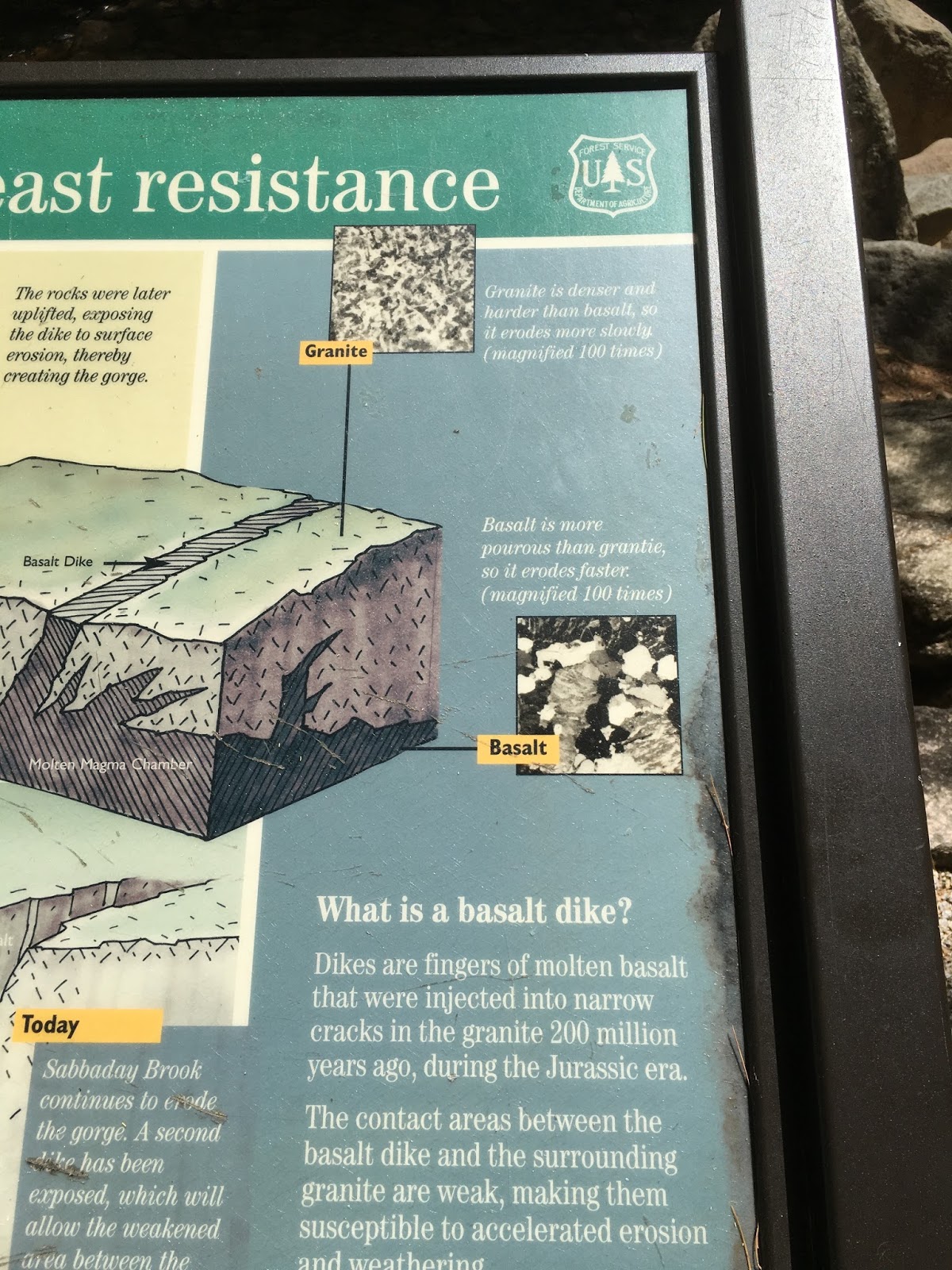
In addition, these Falls had a basalt dike which is a key indicator of volcanic activity; many of these are also found in Hawai’i.

basalt dike / Sabbaday Falls, NH / June 2016 

explanation of basalt dike / Sabbaday Falls, NH / June 2016

This dike played a part in the current pathway of the falls.
basalt dike within the falls / Sabbaday Falls, NH / June 2016 

diagram of falls formation / Sabbaday Falls, NH / June 2016


boiling pot-like formations / Sculptured Rocks, NH / June 2016
This area in New Hampshire was called Sculptured Rocks and it reminded me of the Boiling Pots on Hawai’i Island
boiling pot-like formations / Sculptured Rocks, NH / June 2016


dramatic water erosion / Sculptured Rocks, NH / June 2016


The dramatic rounded erosion occurs in such a very short space and is very picturesque. The extensiveness is perhaps due to great amounts of rushing water for a longer time which would be expected in the glacially affected Northeast.


Sabbaday Falls also had a “pothole” near the base of the falls which may have been formed by water erosion of less dense rocks.
pothole / Sabbaday Falls, NH / June 2016
Whenever you travel airways, pathways, and roadways, keep “watching out for nature” to see the wonders of how our Earth’s surface has changed in the past and continues to change.

Friday, July 1, 2016

“Monument Birds”… and some squirrels!

In our recent visit to Washington DC, we found our nation’s capital to be a city bustling with important and vital activities. The National Mall and surrounding areas are a wondrous credit to our forefathers, and more current political leaders, with so many stories of our nation’s history to teach us. National Park Map Our experiences there were eye-opening, awe-inspiring, magnificent, and incredibly informational about the beginnings and leaders of our country. 

We were very grateful to have some special tours, arranged through our senator, Brian Schatz and his staff. The most amazing one was a V.I.P. Department of Interior tour led by an amazingly knowledgeable National Park ranger who was very passionate about the many memorials and monuments on her tour. 

During our visit there, as I began to take photos, I thought of my first blog topic - monument birds!

World War II Memorial / Washington DC / June 2016 

World War II Memorial / Washington DC / June 2016


Yes, there are the ever-present eagle symbols but I mean, of course, the real birds (and squirrels) making the parks, pools, and green areas their home. 


It was fun to capture the wildlife placidly carrying out their lives amid the backdrops of monumental memorials! There is so much green space, open areas, and water balanced with the large momentous granite and marble stone memorials the birds and squirrels are perfectly able to survive.

Eastern Gray Squirrel / Lafayette Circle / June 2016

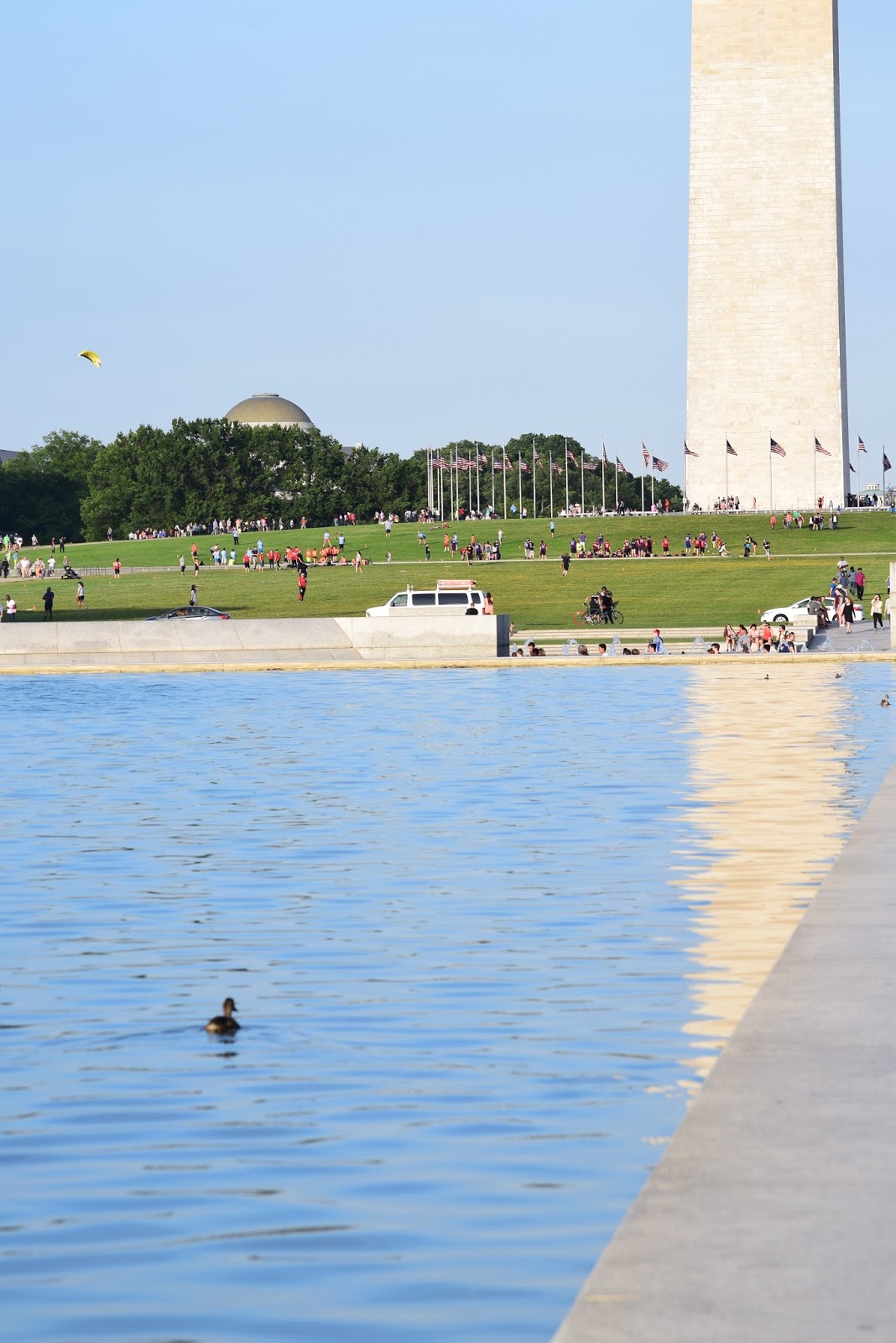
Mallard Duck / Reflecting Pool / June 201


Canadian Geese / Tidal Basin / June 2016


The animals may be attracted to all the human activities around but surprisingly, and miraculously, I did not see any one feeding birds or squirrels. I think all the people are so busy being awed by all that they see every time they turn around that the birds and squirrels are able to just fade into the foreground! So hopefully the wildlife there is eating naturally.


At Lafayette Park, across from the White House, there were many squirrels. We were forced to walk into this park because when the President is present, the roads on either side of the White House are closed off to visitors. So we sat, gazed at the White House, and saw squirrels - black and gray! The black and gray are apparently the same species of Eastern Gray Squirrel.
Eastern Gray Squirrel / Lafayette Circle / June 2016 
Eastern Gray Squirrel, black variety / Lafayette Circle / June 2016


An article on the origin of the Black Squirrel in Washington DC


Eastern Gray Squirrel / near Lincoln Memorial / June 2016

Eastern Gray Squirrels / Federal Circle Metro area / June 2016
North American red squirrel / near Korean War Veterans Memorial / June 2016
I also saw squirrels closer to the monuments. 


One was enjoying the cool of the stone.


Around the deserted Old Post Office Tower building / Federal Circle Metro area, behind the gates, two squirrels were chasing each other. It was almost like the pair was running home!


I sighted a possible North American Red Squirrel near the Korean War Veterans Memorial.


Mallard Ducks / Reflecting Pool / June 2016
In and around the large Reflecting Pool, there were many families of Mallard Ducks. The ducks were very happily prolific. The adult females all seemed to be close together so it was hard to tell who the mother was. 

Mallard Ducks, female and young / Reflecting Pool / June 2016


Mallard Ducks / Capitol Reflecting Pool / June 2016

Mallard Ducks, female and young / Capitol Reflecting Pool / June 2016


This mother at the Capitol Reflecting Pool couldn’t have been the mother to all those babies could she? 


The ducks were active even as the sun set!

Mallard Ducks / Reflecting Pool / June 2016
There was a black bird with her young; unfortunately I didn’t photograph the feeding of the young which I did observe. 

Unknown black bird with young / near the Washington Monument / June 2016
Crow / on Korean War Veterans Memorial figure / June 2016


There were Crows arrogantly claiming disrespectful perches at the Korean War Veterans Memorial.


Crow / on Korean War Veterans Memorial figure / June 2016


There were Pigeons but luckily not many. How do they keep the pesky and pooping pigeons away from all those memorials and monuments?


Pigeons / The Mall / June 2016
There were also Canadian Geese enjoying the Tidal Basin. Perhaps the geese appreciate a larger waterway and/or salt water.


Canadian Geese / near Thomas Jefferson Memorial / June 2016

I believe there is a Cormorant among the geese at the Thomas Jefferson Memorial!

Canadian Geese / near Thomas Jefferson Memorial / June 2016
On one of our last days, we spotted two different songbirds in, and near, the United States Capitol grounds. One was singing within the grounds.

Unknown song bird / U. S. Capitol grounds / June 2016


Unknown song bird / lamp post across from U. S. Capitol grounds / June 2016
We saw this unusual song bird on a lamp post outside the United States Capitol grounds. 


I spent a great deal of time trying to identify the bird but could not. Perhaps it is a Northern Mockingbird? The song and wing coloring sound and look correct but overall it doesn’t match in appearance. Bird identification It looks like a White-Collared Blackbird but that bird is only found in Asia. 

I was lucky to capture the song bird’s complex song and unusual behavior!

Unknown song bird / lamp post across from U. S. Capitol grounds / June 2016

Hopefully some day you are able to go (or go again) to Washington DC to view all the wonder of our nation’s capital and the city's centers of government, museums, memorials, and monuments. 

While you are there, as always, “watch out for nature” and see the birds and squirrels living there oblivious of their auspicious urban home!